
Healthcare organizations lose three things to manual document intake: staff time, data accuracy, and the audit trail that compliance now requires. Manual document intake is where the loss begins. Every referral, prior authorization, and intake form arrives by fax or PDF. Someone has to read it, interpret it, and key it by hand before care can move forward. That manual step feels unavoidable, yet it is where delays, denials, and compliance gaps quietly begin. This post explains what manual document intake costs a healthcare operation, and how a governed system closes the gap.
Why Is Manual Document Intake Such a Quiet Problem?
Manual document intake is a quiet problem because each individual document seems manageable, while the cumulative cost stays hidden. A referral arrives by fax. A coordinator reads it and pulls out the patient details, the diagnosis, the requested service, and the insurance information. Then they enter all of it by hand. One document takes a few minutes. The trouble is volume.
In a busy practice, those minutes compound into a structural burden. As prior authorization research shows, physicians average 39 prior authorizations per week, and their staff spend roughly 13 hours on the related activity. The intake work hides in plain sight because no single document looks like a crisis. The crisis only appears in aggregate. It shows up as a backlog, a missed deadline, or a denial that traces back to a value someone keyed incorrectly days earlier.
The Three Costs Hidden in Manual Document Intake
Manual document intake carries three costs, and in healthcare each one lands harder than in other industries. Each cost traces back to the same hand-keyed step. Time is the first and most visible. Every document read and keyed by hand consumes coordinator capacity that a clinic running high referral volume cannot easily add. As analysis of clinic data-entry cost shows, referral intake runs about 12 minutes per document. A clinic processing 4,300 documents a month needs the equivalent of 3.2 full-time staff for data entry alone. A practice handling dozens of referrals a day would need several times its current staff to do every step by hand without dropping anything.
Accuracy is the second cost, and in healthcare it has clinical and financial weight. A transposed digit or a missed field on a referral becomes a downstream error in care or billing. As prior authorization denial analysis confirms, missing or incomplete clinical documentation drives 35 to 40 percent of denials. Most of those denials are preventable with complete information at intake. The error introduced at the keyboard becomes a denied authorization weeks later.
Compliance is the third cost, and it is the one manual intake hides most completely. When a coordinator keys a referral by hand, no record captures what the source document said, what was extracted, or who confirmed the values. The data enters the system, but the evidence of how it got there does not. In a regulated healthcare environment, that missing evidence is a compliance gap waiting for an audit to find it.
Why the Bottleneck Sits on the Provider Side
The intake bottleneck increasingly sits with the provider, not the payer, because new rules tightened payer timelines while provider intake stayed manual. As analysis of CMS 2026 timelines explains, payers must now answer standard prior authorization requests within seven days and urgent ones within 72 hours. The payer side is getting faster by mandate. The provider side, meanwhile, still loses three to seven days to manual submission built on hand-keyed intake.
This reframes where the delay actually lives. For years, providers experienced prior authorization as a payer problem, a matter of waiting on a slow response. The regulation has shifted the pressure. The slowest step is now often the provider organization reading, extracting, and entering the documents that start the process. A clinic that fixes its document intake fixes the part of the timeline it actually controls.
How Does Governed Document Intelligence Change Intake?
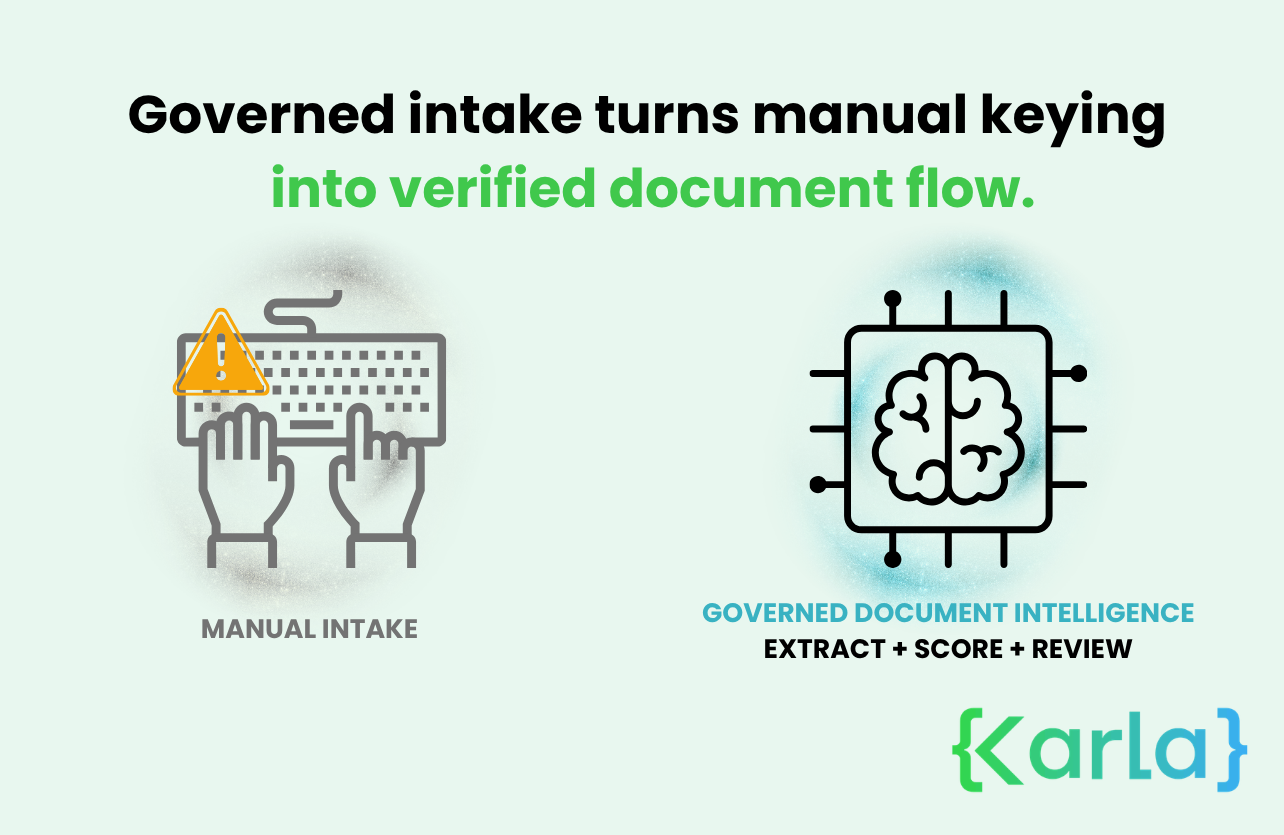
Governed document intelligence changes intake by extracting the data automatically, scoring its confidence, and routing uncertain values to a qualified reviewer, all while recording every step. Karla, the Kohezion AI document intelligence suite, reads an incoming referral or intake document, classifies it, and extracts the patient details, diagnosis, service, and insurance fields. It does not simply dump the data into the system. It attaches a confidence score to each field and flags the ones that need human confirmation.
This is the difference between digitizing intake and governing it. A high-stakes field that the system reads with low confidence routes to a coordinator for review rather than entering the record unchecked. Every extraction and every confirmation is logged, so the audit trail builds itself as the work happens. The coordinator stops being a transcriptionist and becomes a reviewer of exceptions. Volume that used to bury the intake queue moves through a governed process instead. The compliance record exists by default rather than by reconstruction.
The Order Matters
Manual document intake looks like an administrative task, but in a regulated healthcare operation it is the first point where time, accuracy, and compliance are won or lost. Adding staff treats the symptom while leaving the manual process in place. Governing the intake treats the cause, turning a hand-keyed bottleneck into a recorded, validated, auditable step. For healthcare organizations ready to replace manual document intake with governed document intelligence, Karla provides the extraction, validation, and audit trail that intake has been missing. Talk to a Kohezion expert to see how Karla fits your intake workflow.
