
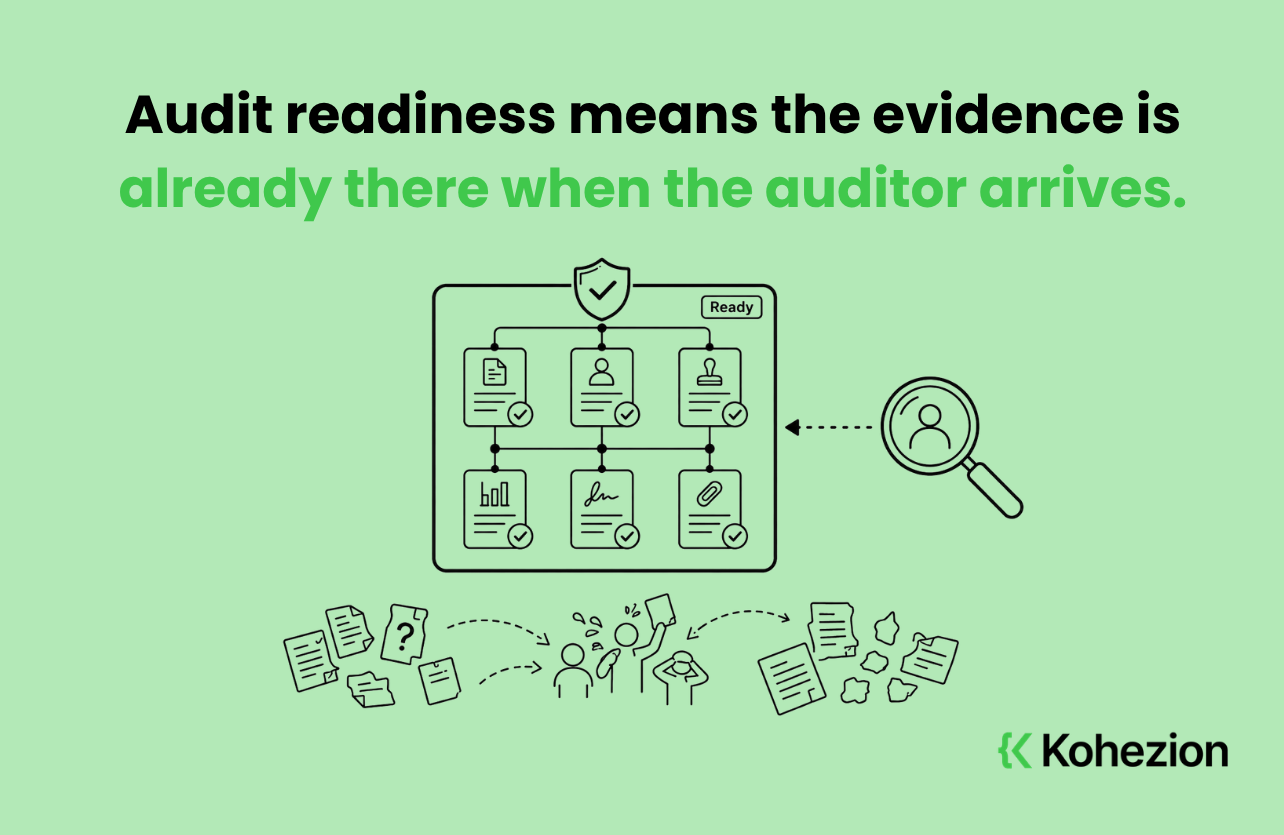
Here is an uncomfortable definition of audit readiness. If your team needs a week to get ready for an audit, you were not audit-ready. You were audit-preparable, which is a different thing. Real audit readiness is not how quickly you can assemble the evidence when the notice arrives. It is whether an audit could begin today, with no notice, and your systems could already answer. This post argues that audit readiness is a property of how you operate every day. It is not a sprint you run a few times a year. That difference is the whole game.
What Does Audit Readiness Actually Mean?
Audit readiness means being in a state where an audit could start without a scramble, not being able to produce a scramble quickly. The distinction matters because most organizations quietly define readiness as the second thing. They measure it by speed, by how fast the team can pull evidence, reconcile records, and patch the gaps that opened since the last cycle. As analysis of audit readiness explains, that is audit readiness as a sprint: reactive, expensive, exhausting, and it never actually stops. Genuine readiness is the opposite. It is a posture the organization holds continuously, so the audit finds the evidence already there.
The test is simple and unforgiving. If an auditor arrived unannounced this morning, what could your systems prove right now, without anyone preparing anything? Whatever the honest answer is, that is your actual audit readiness. Everything you would need a week to assemble was never readiness. It was a gap you had learned to close under pressure.
Why Is Preparing for an Audit a Warning Sign?
The need to prepare is itself the diagnosis. If a team has to gather evidence before an audit, the system was not capturing that evidence as the work happened. Something was missing from the daily operation. The preparation week is when the organization quietly manufactures what the system should have recorded all along.
This is why the preparation sprint is a symptom, not a solution. As analysis of periodic compliance notes, periodic audits can take eight to ten weeks of intense effort, and a team running several frameworks is never running one sprint a year but several, with overlap, until the sprint never really ends. The scramble is not the price of an audit. It is the price of a system that was not capturing evidence in the first place.
The Cost of Treating Readiness as a Sprint
Treating audit readiness as a sprint carries costs that outlast the audit itself. The most obvious is the recurring drain of time, as the same reconstruction happens every cycle. But the deeper cost is that a sprint hides risk between audits. A gap that opens the day after one audit sits undetected until the next preparation window, months later, exposes it.
There is also an accuracy cost. Evidence reconstructed under deadline pressure is more fragile than evidence captured as the work happened. As analysis of reactive audit preparation notes, last-minute scrambling increases the risk of evidence gaps and incomplete documentation, because retrieving thousands of records at the last minute is where things get missed. A posture of continuous readiness removes that fragility, because the system reconstructs nothing at all.
What Real Audit Readiness Looks Like
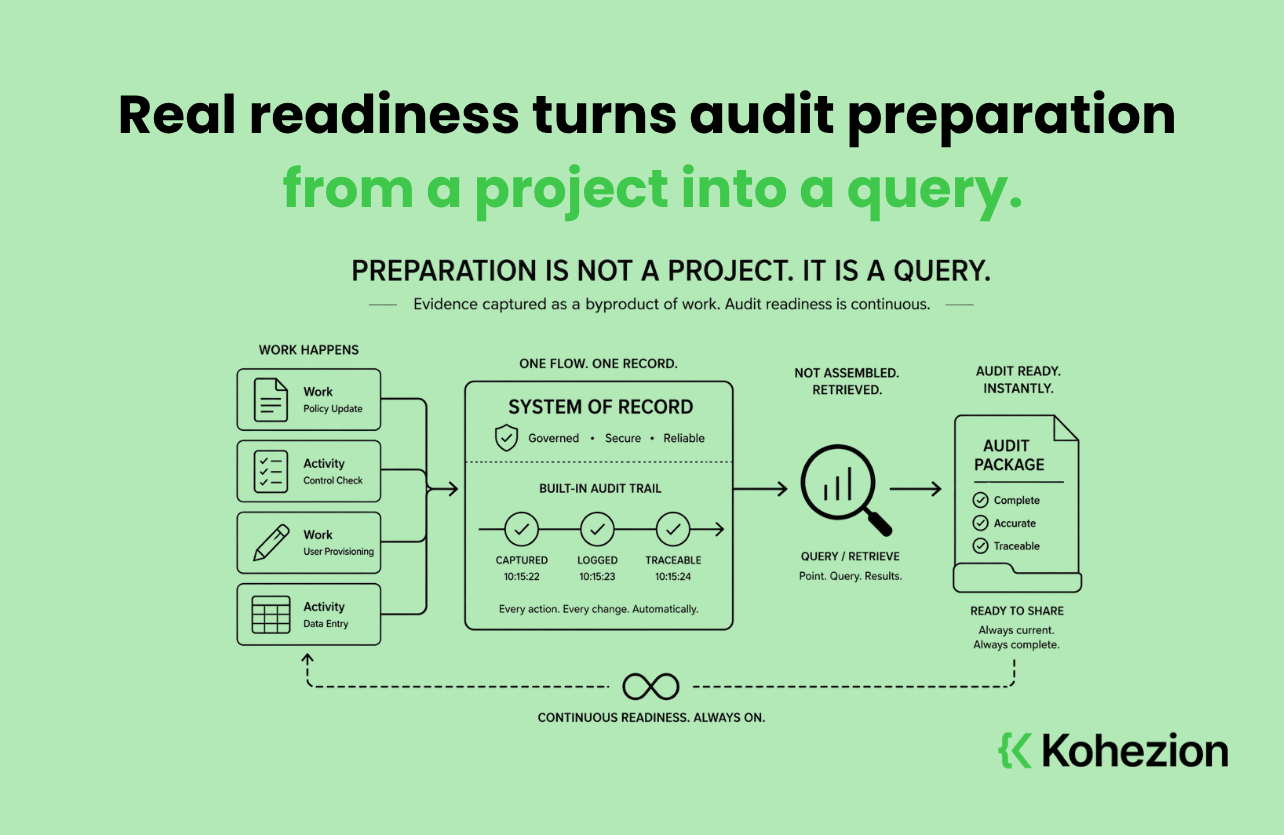
Real audit readiness looks like a system that captures evidence as a byproduct of the work. The audit package is never assembled, only retrieved. It requires that the operational data live in one place, that every action be logged as it happens, and that the audit trail exist by default rather than on demand. When those conditions hold, preparation is not a project. It is a query.
This is what a governed operational system provides in a regulated setting. The work and the record of the work are the same act. So the organization does not become more ready before an audit. It was already ready, continuously, because readiness lives in how the work runs. The audit stops being an event to survive. It becomes a question the system can answer any day of the year.
The Order Matters
The week you spend preparing for an audit is not evidence of your readiness. It is evidence of its absence. A truly ready organization does nothing special when the notice arrives. The systems have been capturing the proof all along. The fix is not a better preparation process or an earlier start. It is a system that makes preparation unnecessary, because readiness is continuous. For regulated organizations that want an audit to be a query rather than a scramble, talk to a Kohezion expert.
